With so many changes happening in XR across the education sector, it is fair to ask a simple question.
Is this market growing or contracting?
On the surface, the signals are mixed.
Meta has scaled back parts of its XR efforts following significant losses in Reality Labs. Apple’s Vision Pro has struggled to find broad adoption at its current price point. Other entrants have yet to break through in a meaningful way.
And yet, most analysts still project strong long-term growth for the category.
So what is actually happening?
A Shift, Not a Slowdown
The consumer VR market has slowed.
But enterprise adoption continues to move forward, particularly in healthcare and education.
The reason is simple. The value is clear.
Use cases such as procedural training, simulation, and visualization remain some of the most effective applications of immersive technology. These are not experimental. They are practical, repeatable, and outcomes-driven.
What has been missing is not demand.
It has been the hardware.
The Evolution of XR Hardware
Early immersive headsets were not designed for real-world, front-line use.
Limitations in passthrough, comfort, and usability made them difficult to deploy outside controlled environments.
That is now changing.
Advancements in microLED optics, AI processing, and power efficiency are enabling a new generation of XR devices. The industry is shifting toward lighter, more practical “glasses-style” form factors that better align with how people work.
We expect to see a wave of new devices entering the market in 2026 and 2027.
This could mark the long-anticipated inflection point for XR, where performance, usability, and price finally align.
Expanding Beyond the Classroom
At AlensiaXR, we have used this moment to expand our focus.
HoloAnatomy® set a high standard within graduate medical education. It proved what immersive learning could achieve in a structured academic setting.
Now, we are applying those same principles more broadly.
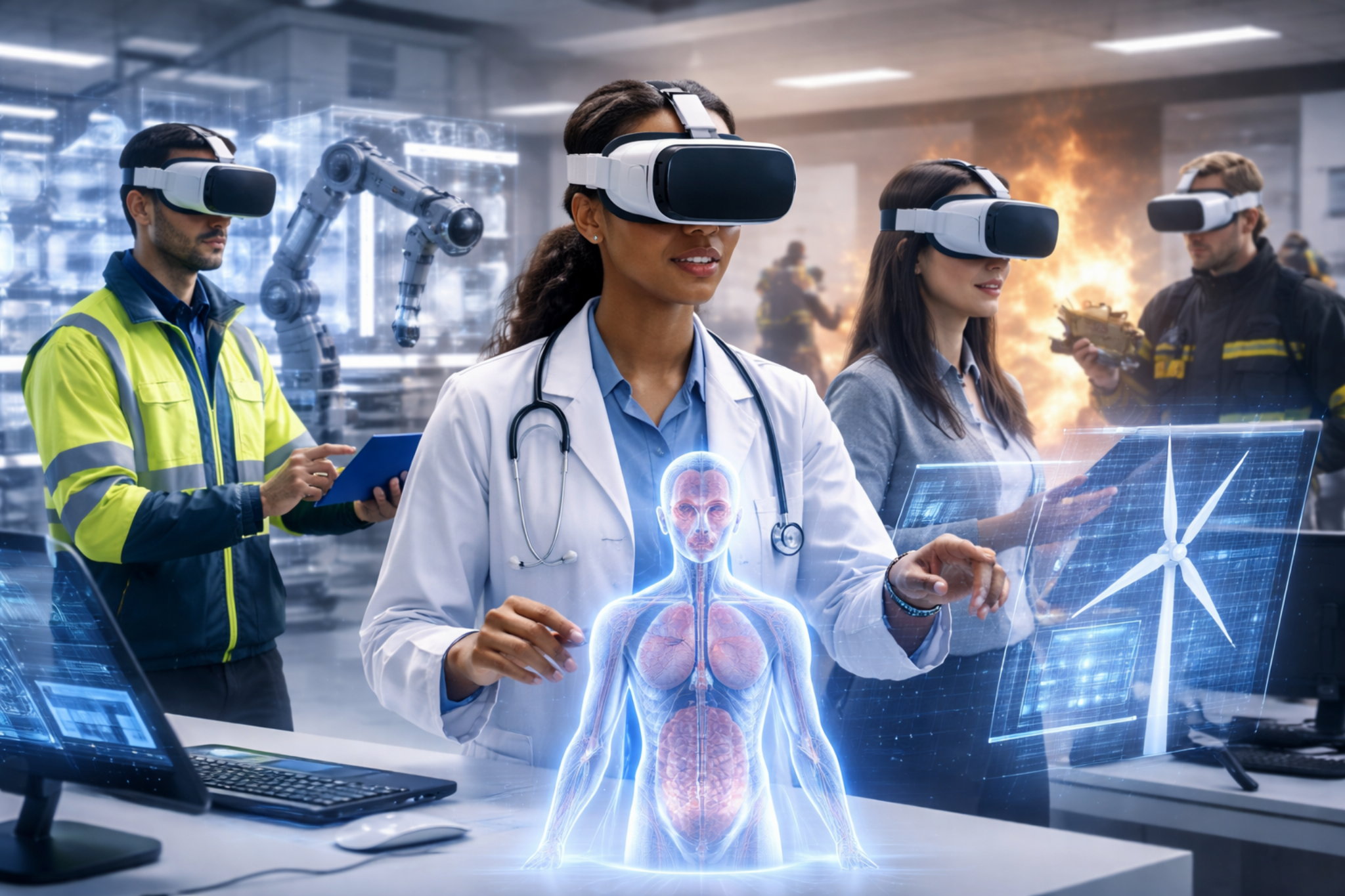
With .NEXT™, we are extending immersive learning beyond traditional education and into real-world environments. The goal is simple. Make high-quality, experiential learning accessible to anyone who needs to understand how the real world works.
This includes not only students, but also the 3 billion frontline workers who learn on the job every day.
A Broader Opportunity Ahead
The future of XR will not be defined by devices alone.
It will be defined by how effectively the technology supports real learning and real work.
At AlensiaXR, we have used this moment in the market to expand our focus.
HoloAnatomy® set a high standard in graduate medical education. It proved what immersive learning can achieve when it is thoughtfully applied.
Now, we are building beyond that foundation.
With .NEXT™, we are extending immersive learning beyond the classroom and into real-world environments. Our approach combines simple, intuitive user experiences, device-agnostic delivery, and AI-driven capabilities to support both structured education and on-the-job training.
Because that is where most learning actually happens.
This shift opens up a much broader opportunity. Not just for students, but for the more than 3 billion frontline workers who rely on continuous, experiential learning every day.
As this category moves toward its next phase of growth, our focus is clear.
Make immersive learning more accessible. More practical. And more aligned to how people learn in the real world.